
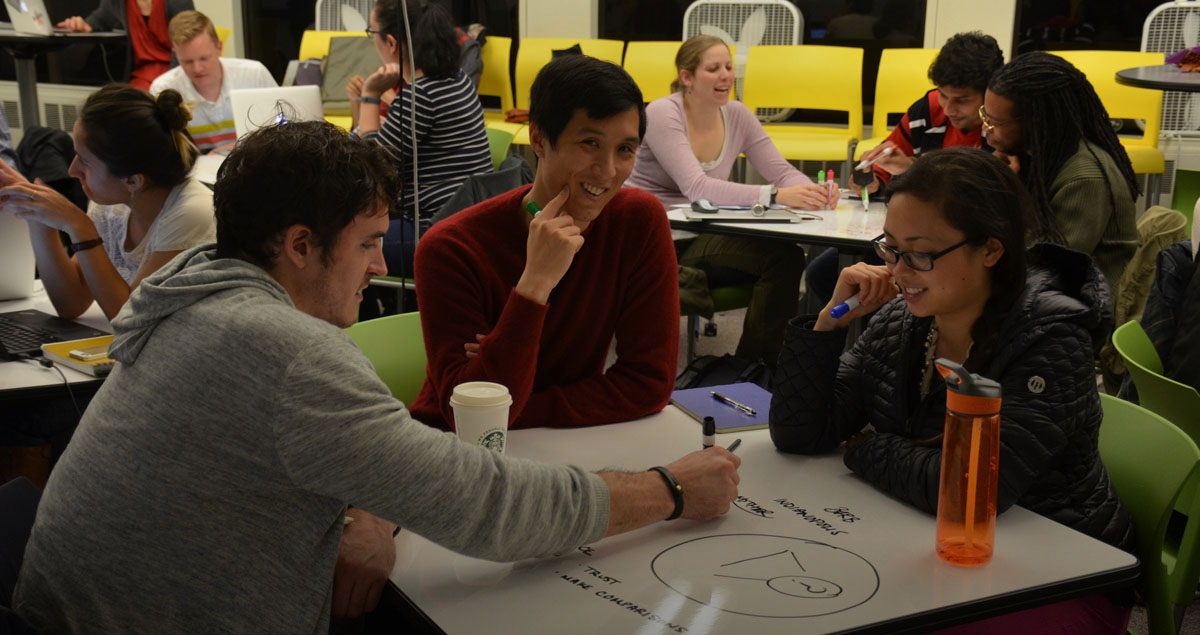
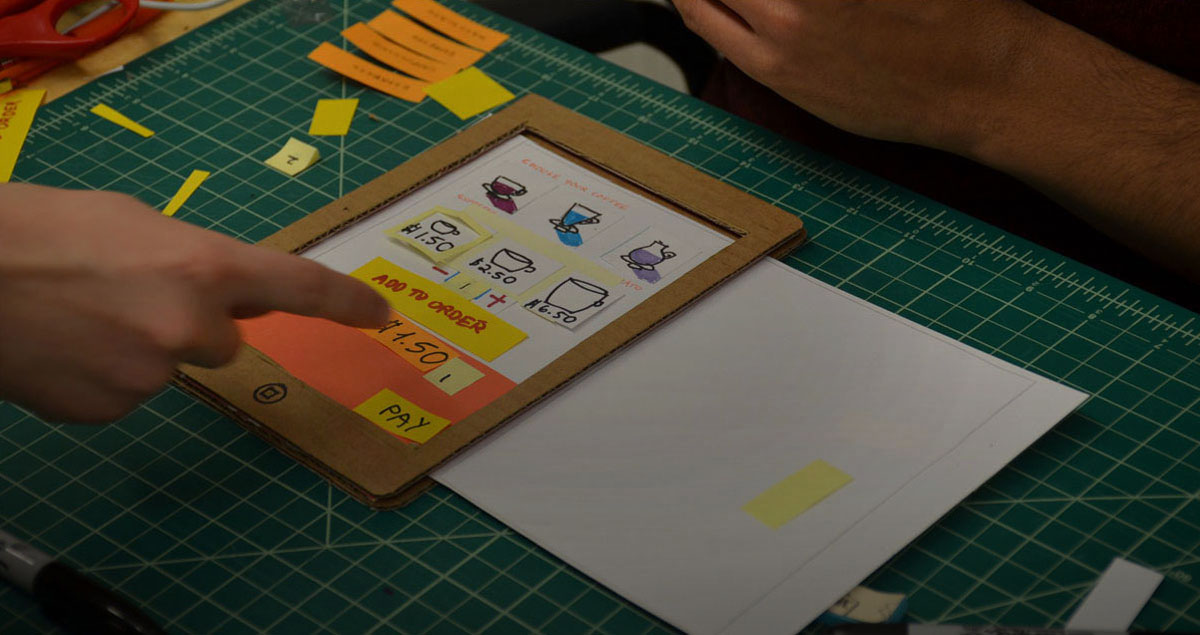
dub is an alliance of faculty and students across the University of Washington exploring Human-Computer Interaction and Design.

Voices from the Rwanda Tribunal: Genocide and Justice

On Tuesday, January 29, 2009, a group of researchers at the University of Washington led by Professor Batya Friedman released "the initial component of a public system to provide authentication for an archive of video interviews with the prosecutors and other members of the International Criminal Tribunal for the Rwandan genocide."

Read more in the original article in the New York Times...

Dub welcomes five new UW faculty members

Charlotte Lee (HCDE) earned a Ph.D. in information studies from UCLA and has underlying degrees in sociology; her focus is in cyber infrastructure and cooperative work. Charlotte comes to us from the University of California Irvine where she is currently employed as a Research Scientist. Charlotte will be joining us in Winter Quarter, 2009.   Julie Kientz (HCDE) has a Ph.D. in Computer Science from the Georgia Institute of Technology. She focuses on determining how novel computing applications can address important social issues and on evaluating them through long-term real world deployment studies using a balance of qualitative and quantitative methods.

  Shwetak N. Patel (CSE, EE) has a Ph.D. in Computer Science from the Georgia Institute of Technology. His areas of interest are HCI, Ubiquitous Computing, and User Interface Software and Technology. He develops easy-to-deploy sensing technologies and approaches for location and activity recognition applications.

 
Andrew J. Ko (iSchool, CSE adjunct) employs a mixture of social science methodology and technical prowess in the study and support of programmers as information workers in need of better tools, particularly for answering "why" questions. He received a Ph.D. in Human-Computer Interaction from Carnegie Mellon University in 2008.  

Sarah Kriz (HCDE) joins us from the Navy Center for Applied Research in Artificial Intelligence where she was a National Research Council Postdoctoral Associate. Her research focuses on human-robot interaction, cognitive design principles, experimental methods, and the interplay between cognitive and social influences. She received a Ph.D. in Cognitive Psychology from the University of California, Santa Barbara.


More news...

Featured at CSCW 2010 Savannah, Georgia, USA
Full Paper

    Multiple Mouse Text Entry for Single-Display Groupware
Saleema Amershi, Meredith Ringel Morris, Neema Moraveji, Ravin Balakrishnan and Kentaro Toyama
   Best Paper Nominee
  Downloads:  [Video
 
Featured at CHI 2010
Full Paper

    Blowing in the Wind: Unanchored Patient Information Work during Cancer Care
Predrag Klasnja, Andrea Civan, Kenton Unruh and Wanda Pratt
  Project:  PIM-Health
 
CHI Note

    Making Muscle-Computer Interfaces More Practical
T. Scott Saponas, Desney Tan, Dan Morris, Jim Turner and James A. Landay
  Project:  Muscle-Computer Interfaces
 
Featured at AMIA 2009
Full paper

    Using Mobile & Personal Sensing Technologies to Support Health Behavior Change in Everyday Life: Lessons Learned
Predrag Klasnja, Sunny Consolvo, David W. McDonald, James A. Landay and Wanda Pratt
  Project:  UbiFit
 
Featured at ITS 2009 Banff, Alberta, Canada
Full Paper

    Enhancing Input On and Above the Interactive Surface with Muscle Sensing
Hrvoje Benko, T. Scott Saponas, Dan Morris and Desney Tan
  Project:  Muscle-Computer Interfaces
  Downloads:  [Video
 
Featured at UIST 2009 Victoria, BC, Canada
Full Paper

    Activity Analysis Enabling Real-Time Video Communication on Mobile Phones for Deaf Users
Neva Cherniavsky, Jaehong Chon, Jacob O. Wobbrock, Richard E. Ladner and Eve A. Riskin
  Project:  MobileASL
 

    Bonfire: A nomadic system for hybrid laptop-tabletop interaction
Shaun K. Kane, Daniel Avrahami, Jacob O. Wobbrock, Beverly Harrison, Adam D Rea, Matthai Philipose and Anthony LaMarca
 

    Enabling Always-Available Input with Muscle-Computer Interfaces
T. Scott Saponas, Desney Tan, Dan Morris, Ravin Balakrishnan, Jim Turner and James A. Landay
  Project:  Muscle-Computer Interfaces
  Downloads:  [Video
 

    Mining Web Interactions to Automatically Create Mash-Ups
Jeffrey P. Bigham, Ryan S. Kaminsky and Jeffrey Nichols
 

    Overview-Based Examples Selection in Mixed-Initiative Interactive Concept Learning
Saleema Amershi, James Fogarty, Ashish Kapoor and Desney Tan
 
Tech Note

    Optically Sensing Tongue Gestures for Computer Input
T. Scott Saponas, Daniel Kelly, Babak A Parviz and Desney Tan
 
Note

    TapSongs: Tapping Rhythm-Based Passwords on a Single Binary Sensor
Jacob O. Wobbrock
 
Featured at ASSETS 2009 Pittsburgh, PA, USA
Full Paper

    ClassInFocus: Enabling Improved Visual Attention Strategies for Deaf and Hard of Hearing Students
Anna C. Cavender, Jeffrey P. Bigham and Richard E. Ladner
   Best Student Technical Paper Award
  Project:  DHH Cyber Community
 

    Freedom to roam: A study of mobile device adoption and accessibility for people with visual and motor disabilities
Shaun K. Kane, Chandrika Jayant, Jacob O. Wobbrock and Richard E. Ladner
 
Featured at ECSCW 2009 Vienna, Austria
Full Paper

      Collaboration in Metagenomics: Sequence Databases and the Organization of Scientific Work
Matthew Bietz and Charlotte P. Lee
 
Featured at INTERACT 2009 Uppsala, Sweden
Full Paper

      Exploring cross-device web use on PCs and mobile devices
Shaun K. Kane, Amy K Karlson, Brian R Meyers, Paul Johns, Andy Jacobs and Greg Smith
 
Featured at IPCC 2009
Full Paper

    Mobile phone users in Kyrgyzstan: A case study of identifying user requirements for diverse users
Cynthia Putnam, Emma J. Rose, Rebecca Walton and Beth Kolko
 
Featured at ASONAM 2009
Full Paper

      Getting online but still living offline: the complex relationship of technology adoption and in-person social networks
Cynthia Putnam and Beth Kolko
 
Featured at Computer 2009
Journal Article

    Designing for Behavior Change in Everyday Life
Sunny Consolvo, James A. Landay and David W. McDonald
  Project:  UbiFit
 
Featured at MobiSys 2009 Krakow, Poland
Poster

    Augmenting Images with Context on Mobile Devices
Harlan Hile, Radek Grzeszczuk, Ramakrishna Vedantham, Jana Kosecka, Alan L. Liu and Gaetano Borriello
 
Featured at ITID 2009
Journal Article

      Skills Are Not Binary: Nuances in the Relationship Between ICT Skills and Employability
Rebecca Walton, Cynthia Putnam, Erica Johnson and Beth Kolko
 
Featured at GROUP 2009
Full Paper

      Locating Patient Expertise in Everyday Life.
Andrea Civan, David W. McDonald, Kenton Unruh and Wanda Pratt
 

More publications...

Downloads

ActivityDesigner
ActivityDesigner: Activity-Based Prototyping of Ubicomp Applications
Version 1.0 Beta 10 now available, including Linux and Mac OS X!

ActivityDesigner is a suite of tools for prototyping and testing ubiquitous computing applications in situ. It allows designers to incorporate large-scale, long-term human activities as a basis for design. It speeds up the design of ubicomp applications by providing integrated support for modeling, prototyping, deployment and in situ testing. ActivityDesigner prototypes can run on various target platforms including mobile phones.
more >>


SUPPLE
SUPPLE: Automatically Generating User Interfaces
Version 1.0 now available, including Linux and Mac OS X!

SUPPLE is an application and device-independent system that automatically generates user interfaces for a wide variety of display devices from a single abstract functional model. Written in Java, it works on Linux, Mac OS X, Windows and PocketPC operating systems.
more >>


DENIM
DENIM: Sketching Web Sites
Version 2.0 now available, including Mac OS X!

DENIM is a system that helps web site designers in the early stages of design. DENIM supports sketching input, allows design at different refinement levels, and unifies the levels through zooming.
more >>


Topiary
Topiary: Prototyping Location-Enhanced Applications
Version 1.0 now available

Topiary is a tool for prototyping location-enhanced applications. Topiary allows designers to model location contexts via an Active Map, to specifying location-enhanced interactions via storyboards and to easily test a design via a Test workspace, using the Wizard of Oz technique or the real sensor input.
more >>

More Downloads: Papier-Mâché | Quill | SATIN | SUEDE


TIME TO APPLY!

Do you want to join one of the most vibrant HCI & Design communities in the world? Contact us on our admissions & hiring info page.

To get involved in dub, join the mailing list.